Monday, March 14, 2016

Winter? in Vermont, 2016.

The title is correct and there is no misplaced punctuation. The winter of 2016 has been quite confusing.

My son received a dozen new hunting arrows for Christmas and we tested them on the outdoor range wearing T-shirts. We are fortunate to have 10 km. of cross country ski trails close by and we never had enough snow to cover the rocks, roots, and mud and did not ski them once. The fuel tank of the snowblower was refilled for the first use in January and there is still 3/4 of a the gasoline still left un-used. At the beginning of March the apple trees were pruned while we wore  sunscreen on our bare arms. The lack of cold weather kept the frost from going too deep in the roads and consecutive70 degree days during the first week of March melted them off and mud season lasted 36 hours. Turkeys were gobbling at daybreak.

The warm temps and lack of snow were a bit disconcerting. What threw me and has me a bit nervous is seeing Toms in full strut and them calling in  the hens looking to mate and opening day is still seven weeks off.

The warm temperatures and lack of snow has a huge impact on the economy of Vermont. The ski areas usually blow snow to augment natural snowfall which was well below normal and warm temps kept many areas from making much snow at all. The people who rely on snowfall to generate work; snow plowing, roof shoveling, repair of vehicles and roofs; took it even worse. The only water falling from the sky fell as rain and just ran off into the rivers and had minimal effect on recharging the aquifers.

Hearing the first gobbles of a new season is always exciting. Hearing the first gobbles of the new and early warm weather was a bit disconcerting. My hope is the birds are photo period sensitive and not just warm weather activated. It would suck if the hens were all bred out causing the Toms to become less excited by a good yelp on a call.

My hope is the lack of snow allowed the birds to eat and grow all winter and the  Toms will be huge and filled with energy. With no snow and mild temps, beards ill not have become broken and the Toms will be tripping over them when they strut. Easily found food should go to building long spurs and not spent as calories to keep warm.

Soon it will be time to re-tune my bow for the Bullheads, cover the bow with  fake leaves, and get ready to get up well before dawn, walk to my spot and listen to the world come alive.

Those gobbling Toms were excited and so am I. Opening day is just around the corner.

Mud season was short but intense. The end of the driveway was an absolute mess. The rest of the road was pretty aweful too


Friday, November 27, 2015

Turkey Hunting, in the Rain, with a Twelve Year Old. Part 3


“Still having fun even with the missed opportunities?”

“Yup. Dad, I can’t wait to actually take a good shot at a turkey. Think we’ll get one here?”

Nathan still had enthusiasm in his voice. My overriding fear has been projecting my desires upon his hunts.  Without the ability to echo locate birds by calling and getting a gobbling response, chasing turkeys in the fall requires so much more effort then in spring. Bumping the flock more then once has typically changed their habits; habits I’ve spent the past few months figuring out. The operative word is “I,” and admittedly, there is a conflict between wanting to keep the birds for myself and sharing them with Nathan knowing he might not be patient enough to put himself close enough for a shot. Fortunately, my selfish thoughts only pass through and don’t stick around..

Expecting an enthusiastic 12 year old boys to be able to sit still for an hour, not drag his feet through the dry leaves, or truly understand how difficult it is to put the birds in front of him, is unrealistic. So what if he gets busted. If he learns how to move with stealth and good woodsmanship while enjoying the outdoors does scaring off a flock of turkeys really matter in the grand scheme of things? Not at all. He is out in the woods and not sitting around at home.

The farm road skirts the edge of the pasture and is defined by an electric fence and the woodsline. Sometimes there are cattle in the fields making the stalking a bit of a challenge. Seems turkeys don’t really like the company of cows.

“Hard to say unless we go take a look. If they are here we can sneak around and get a shot. We just need to be careful popping up over the lip of the field.”

This plot of land borders the Connecticut River and is supposedly the bottom of ancient Lake Hitchcock, an Ice Age lake which abruptly drained 10,000-12,000 years ago. This rapid draining left the steep ravines and convoluted topography we hope to exploit when sneaking up on a flock. Many of these ravines are covered by open hardwoods and capped by extremely flat terraces which have been cleared for farming and grazing. A fortunate byproduct of this terrain is fantastic turkey habitat.

The cow pasture and terraces are separated by a creek just large enough to keep the cattle from wandering randomly between the high ground and the lower pastures. With the cows down low the turkeys should have no fear and inhabit the fields above.

Climbing the dirt ramp in the rain is quiet except for the increasing sound of our breathing. Approaching the lip we drop to hands and knees finishing the ascent by crawling towards the base of the honey suckle. Looking through the brush we don’t need the binos to pick out three flocks of birds. One about 200 yards directly in front of us; another sunning themselves under an apple tree 300 yards to the west; the last bunch is spread out among the old stone walls and scrub brush dotting the hills to the north and too far away to consider chasing.

The birds straight away begin disappearing over the far bank. My watch says 1:20 PM. In the event we are busted by the apple tree gang, there is a good chance this group will be available in the coming days.

            Nathan grabs the binos and slides beneath the brush propping himself up on his elbows laying prone to keep out of sight.

            “There’s a bunch of hens and a few toothbrush toms. They’re just hanging out pecking at stuff. There are a few of them wandering off to the right.”

            “What do you ant to do? Watch a bit more or try to get set up on them?”

            “Let’s move and try to get to the pine trees.”

            Nathan slides back through the brush and hands me the binos. We drop back to the creek and move along the floodplain towards the head of this small valley. Nathan scrambles up the bank to see if the flock has moved.

            Approaching the crest of the slope, Nathan crouches behind the ragweed lining the border between the trees and the field. He stands peering over the vegetation and suddenly drops to his knees. He look down at me and rapidly points up the hill.

            Without making a sound my mouth moves, ”What?”

            Nathan mouths back and points up the hill, “They’re right there.”

            Now in full pantomime we communicate for him to keep moving to the right and try to get around the pine trees at the bend in the field, set up and wait. The wet ground helps him move with a bit of stealth but his need to keep an eye on the birds increases the chance of him getting busted. If he does, he does and with a bit of self-convincing I’m okay with whatever happens.

            I reach the trees before Nathan and we set-up on the back side of an overgrown pasture pine. The flock should be on our left, walk past the trees and away from our position while providing a chance to draw the bows and get a shot.

            The clucking and yelping to our left grows louder as the birds close the distance. To the right, we begin to hear the moooo of cows. The clucks grow louder as does the mooing. The cows down in the  creek bottoms become visible though the trees; the turkeys are abeam of our tree and 40 yards out. They stop, perriscoping their necks to scan the area. Nathan and I don’t breathe to keep any motion to a minimum. When the large black cow steps into the field the turkeys turn and move across the field and are no longer a valid target.

            Nathan lowers his bow and whispers,” Dad, we were busted by cows! That’s so un-cool. Coyotes or bobcats or something considered a predator is one thing but cows? “

            “A first for me too. Let’s sit here for a few moments and let the birds run from the big scary cows before we scoot back down the hill. We should head home. I’m pretty tired.”

            “Sounds good.”

            Watching the turkeys hustle away from the approaching herd of cows really is amusing. The flock stops at the treeline before melting into the weeds and disappearing. Nathan and I get up and begin the 10 minute walk back to the car. We decide to head across the creek bottom and take a direct route to the road to avoid mixing with the herd of cows, and a few bulls, still on the other side of the creek. 

            The slope is open pines with a carpet of fallen needles to absorb each footfall so we move with almost no sound. YELP, YELP, YELP; a hen begins to call together the flock which must have scattered when the cows moved through to head up the hill and subsequently scare off the birds we were on. Tilting my head and pointing my thumb to the right indicating a move to the large bull pine where the slope meets the flat puts us near the closest cover.

            The kee-kee-kee and sharp clucks allow echolocation of the flock’s assembly point. “You see ‘em?” I whisper pointing towards the slope across the flats.

            “No. They sound like they might be on the other side of the creek.” Nathan replies.

            Our current position is pretty good and a successful kill will require the birds to move across the flats and up the hill towards the fields behind us. There is a small clump of brush in the flats but the risk of getting busted is too great so we sit still and listen to the calls which come for out in front of us. The sounds are becoming less frantic and beginning to coalesce within a small oak grove 150 yards away. The flock is back together but appears very paranoid. There is no pecking at the ground or wing flapping. The birds are very still and their head movements are small as they scan the surroundings for predators and latecomers to the assembly.


            When the flock starts purring and the clucking loses a bit of the sharp edge we count eleven hens and one soul patch jake in the mix. Soon the turkeys seem much more relaxed as they begin pecking at the ground, scratching, with much less examining of the surroundings. The creek flat by the oaks is devoid of understory and the birds begin moving towards the fields up high which unfortunately, is away from us. We’ve been sitting for almost forty-five minutes so the knobby forest floor has created a few numb and sore spots on both mine and Nathan’s butts.

            “You want to try and end run those birds and get up the hill ahead of ‘em?” My tone of voice is apathetic.

            “Nah. We’ve been going pretty hard all day and I’m kinda cold and hungry. It was pretty fun hearing those birds calling and we didn’t get busted. There’s always tomorrow and we know where they are and there’s a ton of turkeys in here.”

            When the flock moves out of sight we stand up and brush the pine needles off our pants. Good boots have us walking right through the creek and across the swampy areas which drain into the floodplain. Cows stop eating and turn to watch us stroll across the pasture, jump the barbed wire fence and move along the road to the car.

            Nathan and I encountered a lot of turkeys, heard some awesome calling; and learned a huge amount about the habits of flocks in the rain. No we didn’t get off a shot but watching my son made this one of the best hunting days I’ve ever had.


Friday, November 13, 2015

Turkey Hunting, in the Rain, with a Twelve Year Old. Part 2


Nathan grabbed a hot shower while the old man, me, dug through the refrigerator for lunch. When the tea kettle came to a full boil the hot water filled mugs to bring the black tea steeping to full flavor.  As Nathan found dry clothes, I finished cutting the quesadillas.

The food didn’t last too long or even grace our tongues; we ate fast, dressed warm and headed back out looking for birds. The precip. was more of a drizzle then steady rain. The wind picked up enough to push the small car from side-to-side. The narrow river valley opened up into freshly harvested cornfields bringing new hope to the dreary afternoon.

At this point in the season it is always tempting to fill a tag using the front bumper.

Heading south on route 5, Nathan examined the treeline along the far side of the fields. “No turkeys in there. We should head left and take a look in the Steve’s Rock Field.”

The name of the fields tend to be some reminder of some turkey hunting episode from prior seasons. This past spring, Nathan, Steve, and I slithered along a stonewall adjacent to a large hay field. The flock of hens was leading a few toms quartering away from the wall; the closest bird was maybe 35 yards away. A large boulder marks the end of the stonewall and Steve managed to ooze up and lay the 12 gauge Mossberg across the top without getting busted. BOOM! The sound of the first shot rolled across the valley as the knee high grasses absorbed the shot leaving a disturbance in the otherwise uniform fescue. Steve shucked the first shell and fired again at the running flock. Another miss and the only casualties being some vegitation.

Pulling into the farm road leading into Steve’s Rock the slight hollow near the corn held a flock of about twenty birds. After watching for a few minutes Nathan spoke up.“Let’s head to the rich guy’s place and cut across meadow into the trees. That looks the way they’re going.”

Three minutes later we pulled off the road, jumped into our rain suits, and grabbed our bows. The trees Nathan was referring to sat between the car and the birds. The edge of the field  is dense with honeysuckle and ragweed enabling us to move quite freely closing to within 100 yards of the turkeys. The wind and rain made enough noise to cover the sound of two humans walking in wet grass.

The crux move to getting up close is finding a way through the strip of trees and into the next field. The trees are filled with vines and dense underbrush making any progress difficult. Fortunately, the birds were still in the hollow so we had terrain working to shelter us as we fought between the saplings, and thorny brush. Nathan insisted on trying to sneak through the grass and get close; I made my way to the edge of the tree hoping he might spook them towards me.

A tom just cannot resist showing of for the ladies. caption

My position allowed a good view of both the flock and the boy. Nathan stopped to nock an arrow before crouching and moving on his knees. Fall birds are much more docile and orders of magnitude less paranoid compared to spring. I have no idea how he managed to do it. Ten minutes after beginning his frontal attack on the turkeys he was twenty yards away and still sheltered by the topography. He checked his release and squirmed around getting his feet beneath his legs. In one motion he stood and drew the bow bringing his release hand to anchor. I held my breath not wanting to spook the birds. Nate moved the bow from side to side. “Come on boy, shoot something.” Is all I could think.

HONK, HONK, HONK, mixed in with the yelping and clucking of turkeys. The sounds scattered and six Canada Geese flew away followed by the twenty turkeys. Nathan let down, turned and came towards me.

“What happened?”

“Dad, it was pretty cool. I was pretty nervous sneaking up there. I could hear them clucking, and yelping a bit. When I stood up I had no idea the geese were there too and I kinda freaked out not wanting to shoot a goose which were in front of the turkeys. I jumped when the geese began honking. It was loud. I didn’t want to, well I did but decided not to, take a shot as they flew away. Kinda sucks they got away.”

“Welcome to turkey hunting with a bow. At least you learned something about sneaking up on birds. I’d of thought for sure you’d get busted long before you did. You’re doing great. Hunting them with a bow is hard. Even if you don’t get one your getting well within shotgun range, right?”

 I carried Nathan’s bow while he folded the blades of his Muzzy broadhead on the walk back to the car.

The next set of fields was blank so we kept driving south. A small gang of toms with paintbrush beards sat out in the middle of a posted field. Another flock of hens occupied the space beneath a crab apple tree in someone’s front yard. It was good to see all the birds even if they were not accessible.

The destination fields are bordered by steep ravines, lively creeks with open woods and is one of my all time favorite places to spot and stalk turkeys. The rain stopped falling as we pulled off the road and a few bit of blue sky were visible through the clouds.  So far the day had been fantastic hunting and little did we know the best part of the day stood fifteen minutes in out future.

Good cover but too long a distance for a decent shot.


Stay tuned for part 3

Monday, November 2, 2015

Turkey Hunting, in the Rain, with a Twelve Year Old. Part 1


The Friday before Columbus Day weekend was an in-service day for the teachers and staff of Thetford Academy giving the students the day off. Rain pelted the tin roof while the heavy cloud cover kept the morning in perpetual dawn. Only large patches of any color could be distinguished in the paltry light. With a lack of a brightening day, my internal clock just stopped and only an overpowering need to relieve myself had the ability to force me out of bed. Rain shuts down the outdoor work of landscaping so my day was free to spend at home with the kids and maybe get in a bit of turkey hunting.

Nathan at full draw


Nathan, my twelve-year-old son, can finally pull enough draw weight on his compound bow to generate enough kinetic energy with an arrow to make turkey hunting an ethical pursuit. Shotgun season is still three weeks in the future and in defiance of the rain we suit up and head out the door.

A decade ago my 1985 Yamaha FJ 600 was sold off but I kept the rain suits since they kept me dry traveling through the wet at highway speeds. They should be just fine for stalking turkeys and two suits are stashed in the trunk of the car; one for me, the other for Nathan. If we’re dry we should be warm or at least not too cold.

Rain suits keep water at bay with a trade-off; the suits make similar sounds I recall from my days attending elementary school in the 70’s when corduroy was all the rage. With each step the wale of the material rode past each other producing a staccato, brrrrrip, brrrrip, brrrrrrip. Between classes at the height of corduroy mania the cacophony of walking students was pretty overwhelming. Now, wearing the rain suits, each step had the flared legs rubbing past each other making a whoosh, whoosh, whoosh just loud enough my hope is the rain in the trees will the sound of our movements.

The plan is to spot and stalk the local corn field which have just been cut.  Getting into a car to hunt turkeys is a bit of a bummer when the house is surrounded by fantastic terrain for hunting. Fantastic terrain for hunting vocal gobblers but not so great for locating the more silent birds of autumn.

Five minutes down the road we come to a lake. Not great hunting for turkeys but the valleys with streams and small rivers which drain into the lake provide farmers with rich soils for growing corn. Fresh cut corn usually means feeding turkeys and this morning is no different. Three toms, one toothbrush jake following two legitimate longbeards through the corn stubble. The undulations of the field provide topographic cover. Skulking through the rolling field we take a guess which way the gang will turn when it reaches the treeline. A small creek runs along the field twenty yards inside the trees with the only walkable crossing being a small culvert bridge to the south. Another cornfield covers the valley to the ridgeline once across the creek. We skulk along the creekbank sometimes crawling, other times slithering beneath the brush and reeds of the riparian corridor.

Reaching the bridge Nathan glasses the field to locate the gang which he spots 150 yards up creek of our set-up. All three birds scratch at the bare ground stopping occasionally to look around before continuing the search for kernels having escaped the combine. Soon the gang is 160 yards away. More scratching and moving to 170 yards. We’ve guessed wrong and sit patiently but frustrated at our bad choice of location. We let them move out of sight hoping not to spook them and head up the fields back to the car. Nathan removes his rain suit allowing the car’s heater to better reach his chilled skin.

The turkey drive, as we’ve come to call it, passes two adjacent farms with large paddocks containing the dairy herds. The land is not posted but hunting in a farmyard has the potential to frighten the livestock so we keep moving past a flock of an estimated 50 hens and yearlings picking through cow dung and yard muck.

At the head of the valley the road takes a hard, uphill turn to the right and through the conifers before crossing the ridge. The next valley is a bit tighter with less open cornfields. The terrain more suited to grazing then growing. Coming over a rise the field on the right side of the road contains a small flock of hens. We drive past scouting the fence-line seeking a concealed route into the field. We park 200 yards from the birds. Nathan impatiently exits the car leaving his rain-suit wadded up on the backseat floor. The rain pounds at the windshield turning the outside world into a wavy mirage of trees bisected by the dirt road. Pulling on my vinyl suit before grabbing my bow will keep me dry. By now, having entered the woods, Nathan must be soaked through to his skin. From the roadside I can see the flock and catch occasional glimpses of my son  doing his best to sneak up on the feeding birds.

Nathan has been wanting to go turkey hunting for a few years. He’s been out during the spring with a 20 gauge, single shot, break barreled Winchester  Sitting and waiting for turkeys wasn’t really hto his liking. He really enjoyed the run and gun style of pursuit. Being 12, his need to always see the quarry is understandable even if it’s not the best way to move into bow range of the more docile autumn birds. Today, with wind moving branches and shaking the brush along with heavy rain to soften leaves and alter the wood of dry branches so they yield rather then “crack” under his feet, the odds of his straight forward approach just might work. Successful or not, there is great joy at watching the boy on the hunt.

By some stroke of beginner’s luck or divine intervention, Nathan manages to move past the flock and find a hiding spot behind a small group of honeysuckle still holding its leaves. The flock moves past within twenty yards of the boy. Nathan draws the bow only to let down a moment later. The birds walk off and into the next field, the property line adorned with bright yellow Posted signs. Diplomatic immunity and sanctuary are bestowed upon the birds. Nathan cuts straight across the field to the car.

“No shot?” I call across the field.

“No. I had a shot but wasn’t sure of the distance. It looked about thirty and my pins only go to twenty and it just didn’t look good so I let down. It was pretty fun getting up on them.” He opens the car door setting the bow into the back seat. “I’m kinda cold and wet. I forgot to put on my rain gear.”

A still warm engine brings up the heat pretty fast. Wet bodies, cool outside temps and a small car bring have the windows fogging up in short order. We head home for a hot cup of tea and change of clothes. There is a lot of daylight left in the day along with plenty of rain to keep on hunting.


Monday, October 12, 2015

The First Week of the 2015 Fall Seaon


The excitement of opening day should rival the exhilaration felt by any child on the morning of Christmas, their birthday, or the last day of school. Opening day for fall turkey bowhunting had the same foreboding as property tax day or visit to the dentist.

If there is a good reason for not getting excited about opening day it eludes me. It couldn’t have been more then a day or two after the spring season ended before starting the countdown to October 3rd when Vermont’s fall archery season begins. With a sense of obligation, the hunting day began an hour before sunrise with a cup of hot tea.

Hunting turkeys with a bow has its rewards and is a lot of fun despite the frustrations of having many birds within gun range which is usually just out of bow range. Anything beyond 30 yards is little more then sending the arrow and hoping for a good shot. Because of my last experience with a slow death with a decent body shot, my broadhead of choice is some form of guillotine head. Many arrows with mechanical heads gave a few birds close shaves and the kill or miss philosophy is great if my ego would allow me to go an entire season and come up empty handed; hence the move to large cutting diameters on the fronts of arrows.

Squeezing the tea bag against a spoon to remove the water is a mind-numbing step in the preparation of good tea. The big squeeze adds a touch of bitterness unable to escape into the brew by steeping. Grabbing onto an absorbent sack of just boiled tea leaves is also a bit of a rush which helps me shake off the morning doldrums and get the day started. It is during the squeeze and subsequent burning of my fingers the root for my lack of enthusiasm becomes clear: I have no faith in the ability of the arrows to fly true. With no confidence in my equipment there is no joy in the hunt.

Been keeping an eye on this bird and a few of his running mates.
My Elite Energy 35 is a fantastic bow. What is not so fantastic is my ability to tune it to have the large broadheads fly to where they were aimed. During tuning, both the Muzzy M.O.R.E. heads and the Magnus Bullheads had erratic flight. Bareshaft tuning had the arrows flying consistently but my efforts were slow to bring the fieldpoint and bareshaft arrows to impact near each other. The bareshafts eventually hit within an inch of the fieldpoints with one caveat; the bareshaft arrows were always tail left and no amount of rest moving fixed this.

Just for kicks and with a bit of desperation and tossing caution to the wind I loosened the pinch-bolt for the cable slide-rod. On the Elite bows the rod is slightly S-shaped allowing the user to move the cables towards or away from the string by rotating the rod. The cable-rod was set to give the fletchings minimum clearance with the cables. With the pinch-bolt losse, the rod was rotated 45 degrees placing the slide at the 8 o’clock position when viewed from behind. The bareshaft arrow hit the target slightly tail right and this condition was confirmed with the next three arrows. Turing the rod to the 7 o’clock spot gave a bareshaft arrow which impacted straight into the target. A little more rest movement brought the bareshafts and fletched arrows to the same spot.

The test flight of the Bullheads hit dead on the vertical line painted on an old fiberfilled pillow hung at 20 yards. What about 30? Will the arrow still be on the pillow? Yes it is and remained there to 40 yards. The Muzzys were also spot on but my trust in the setup was clouded by skepticism. Pillows are one thing but will they still fly straight with the added rush of a live shot.

Opening day morning was uneventful. The hunt really amounted to a nice walk in the woods. No turkeys were discovered but I did see a nice 8 point whitetail and managed to stalk it to within 60 yards. I have no interest in hunting deer so getting close is just a warmup for getting close to the birds. The turkey hunting season ends in early November and the plan is to only take a shot at a tom and leave the hens until fall shotgun season when anything within range is fair game.


Sunday, August 30, 2015

They Are Comming Together


The Fall 2015 turkey archery season is just over a month away. Hunting turkeys with a bow is legal between October 3rd and October 23rd. Time to get the bow all tuned up, start a bit of scouting, and practice a few kee kee runs and clucks.

As part if the turkey hunting tune-up, the resident Canada goose season will become part of the training routine. Starting September 1 and running through the 25th, it is legal to take the Canada goose by any legal means. Taking geese with a bow is fully legal and its time to have a go. My home is almost on the border between the Connecticut River zone and the Interior Vermont  zone which presents a lot of opportunities for hunting.

With an incredibly smooth draw cycle, the Elite Energy 35 is the bow of choice for hunting turkeys.  During the summer  it has been my mission to have the bow tunes well enough to properly launch the guillotine style broadheads. The Magnus Bullhead and the leftover Muzzy M.O.R.E. heads (which I panned in an earlier post) are in the growing pile of archery stuff so we'll see if they will fly right and be put into use. A bit of bow tuning and dialing in of broadheads will be the fodder of a near future post.

The last post of any merit was made on July 19 and the turkeys are beginning to flock up. In addition to large groups of poults and hens, there are a few toms lurking along the edges of these gatherings. On occasion there are a few small gangs of  birds sporting impressive beards and taking a mature tom is most definitely on the fall "to do" list.

I hope you enjoy the photo essay of the gathering and growing flocks  here in Vermont.

Turkey and cows both seem to graze out in fields.

If anyone ever wonders if turkeys blend in then please take a look here. The flock had about 20 birds in it and most of them are in or just outside this photo.
Tough to see the beard but this tom is sporting something near 9"

These two are typically with the bird in the photo above.


These hens had just corralled and herded the poults into the ferns on the right side of the road before running for 20 yards and cutting into the woods. This is the first time witnessing any misdirection to take pressure off the little ones.


Lotsa little heads poking up from the grass.

The photo doesn't due these toms the proper justice in terms of showing them as toms. The red head of spring is all but gone and the camera didn't pick up the beards very well. Shooting straight into the sun doesn't help.
The birds in the flock were all within 30 yards of each other and segregated into gender and age appropriate groups.

Sunday, July 19, 2015

Starting to See Them Again

Within a week of putting away the camo, storing the dekes, and removing the broadheads from the arrows , scouting begins for the fall season and upcoming next spring.  Whether or not the scouting is a conscious act or just the remnants of hunting season is unknown. Maybe the visual scouring of fields and woodlines has become habitual. Doesn't matter too mcu; looking for turkeys is an enjoyable part of life.

The most enjoyable part of seeing summer birds is watching the hatchlings grow into poults and grow large enough to make it through the first winter. I like seeing turkeys and seeing turkeys makes me happy and I like being happy.

Being a turkey hunter seeing flocks increase in size is always a good thing when it comes to my obsession. Hunting turkeys is difficult enough without having to search high and low for birds. Even with abundant flocks my success rate is pretty low. Maybe as my skills increase long with a better success rate looking for eligible targets will become a new challenge. Nah, I doubt it. Local healthy flocks are good and I can travel to other areas if the need arises to make the game any more difficult.

The first cut of hay  has been baled  which brings a few more broods into view. Knee high grasses do a fantastic job of hiding full grown hens. The poults are almost impossible to spot unless the hens give away the locations.Just before the hay was cut two hens were crossing the field down the road. Their heads bobbed and weaved with each step and occasionally a small bird was flapping away managing to rise just above the grass before settling down. There might have been one or there might have been one hundred small turkeys trying to fly. They reminded me of watching kernels of corn explode inside an old air-pop machine we use at home. They suddenly appeared before settling back to pop back into the air. The field is just over two hundred yards away from where I took my only spring longbeard and I wonder if any of the pop-corn flight poults was its kin? I sure hope so.

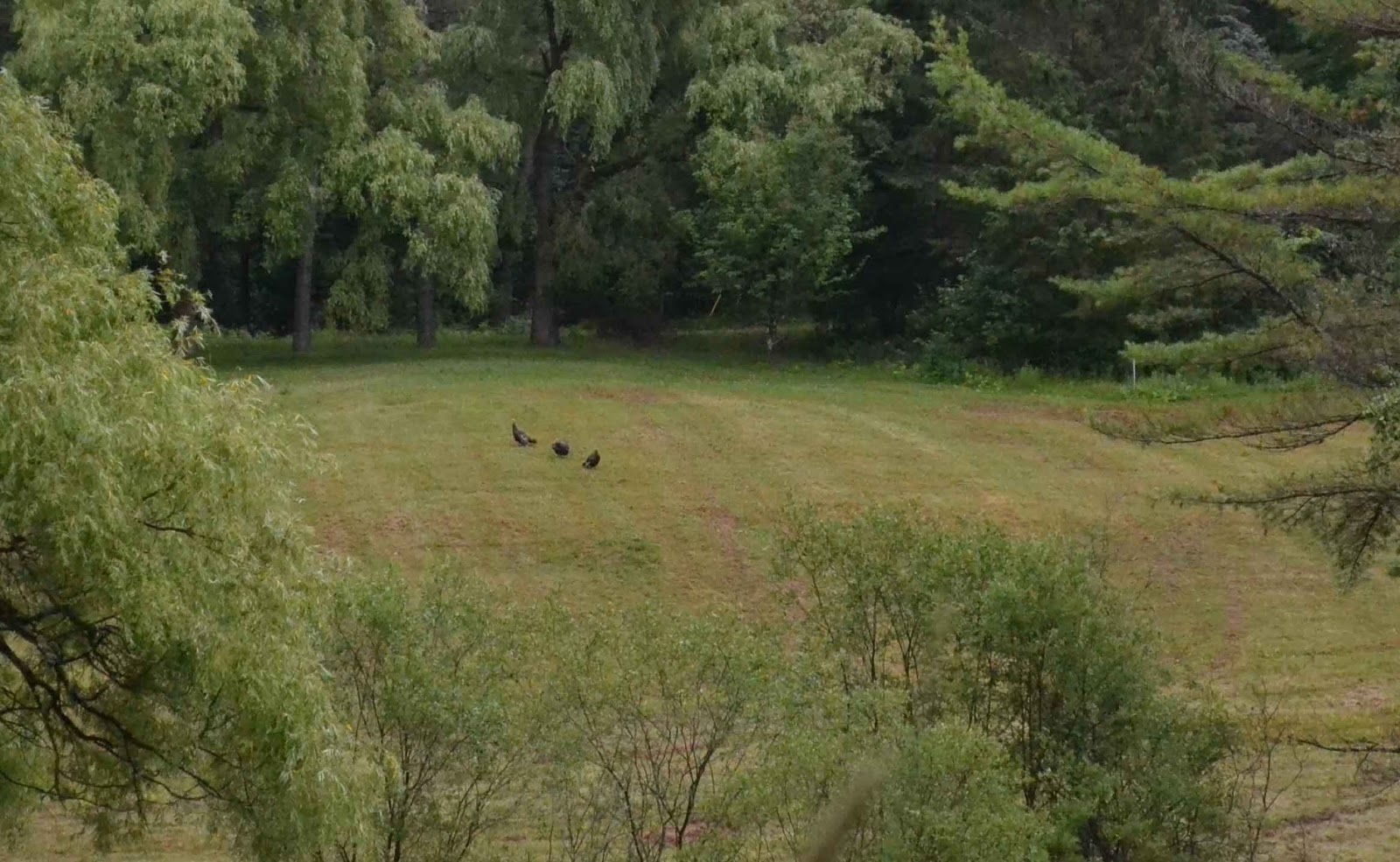
These three hens hav about a dozen poults with them. These were spotted in a field about 150 yards away and the camera lens isn't good enough to make them visible.

Spotted this brood of two hens and six (as best as I was able to count) poults. Some of the poults are visible as the small fuzz just ahead of the left-most hen.

Another small brood to keep an eye upon