Sunday, July 19, 2015

Starting to See Them Again

Within a week of putting away the camo, storing the dekes, and removing the broadheads from the arrows , scouting begins for the fall season and upcoming next spring.  Whether or not the scouting is a conscious act or just the remnants of hunting season is unknown. Maybe the visual scouring of fields and woodlines has become habitual. Doesn't matter too mcu; looking for turkeys is an enjoyable part of life.

The most enjoyable part of seeing summer birds is watching the hatchlings grow into poults and grow large enough to make it through the first winter. I like seeing turkeys and seeing turkeys makes me happy and I like being happy.

Being a turkey hunter seeing flocks increase in size is always a good thing when it comes to my obsession. Hunting turkeys is difficult enough without having to search high and low for birds. Even with abundant flocks my success rate is pretty low. Maybe as my skills increase long with a better success rate looking for eligible targets will become a new challenge. Nah, I doubt it. Local healthy flocks are good and I can travel to other areas if the need arises to make the game any more difficult.

The first cut of hay  has been baled  which brings a few more broods into view. Knee high grasses do a fantastic job of hiding full grown hens. The poults are almost impossible to spot unless the hens give away the locations.Just before the hay was cut two hens were crossing the field down the road. Their heads bobbed and weaved with each step and occasionally a small bird was flapping away managing to rise just above the grass before settling down. There might have been one or there might have been one hundred small turkeys trying to fly. They reminded me of watching kernels of corn explode inside an old air-pop machine we use at home. They suddenly appeared before settling back to pop back into the air. The field is just over two hundred yards away from where I took my only spring longbeard and I wonder if any of the pop-corn flight poults was its kin? I sure hope so.

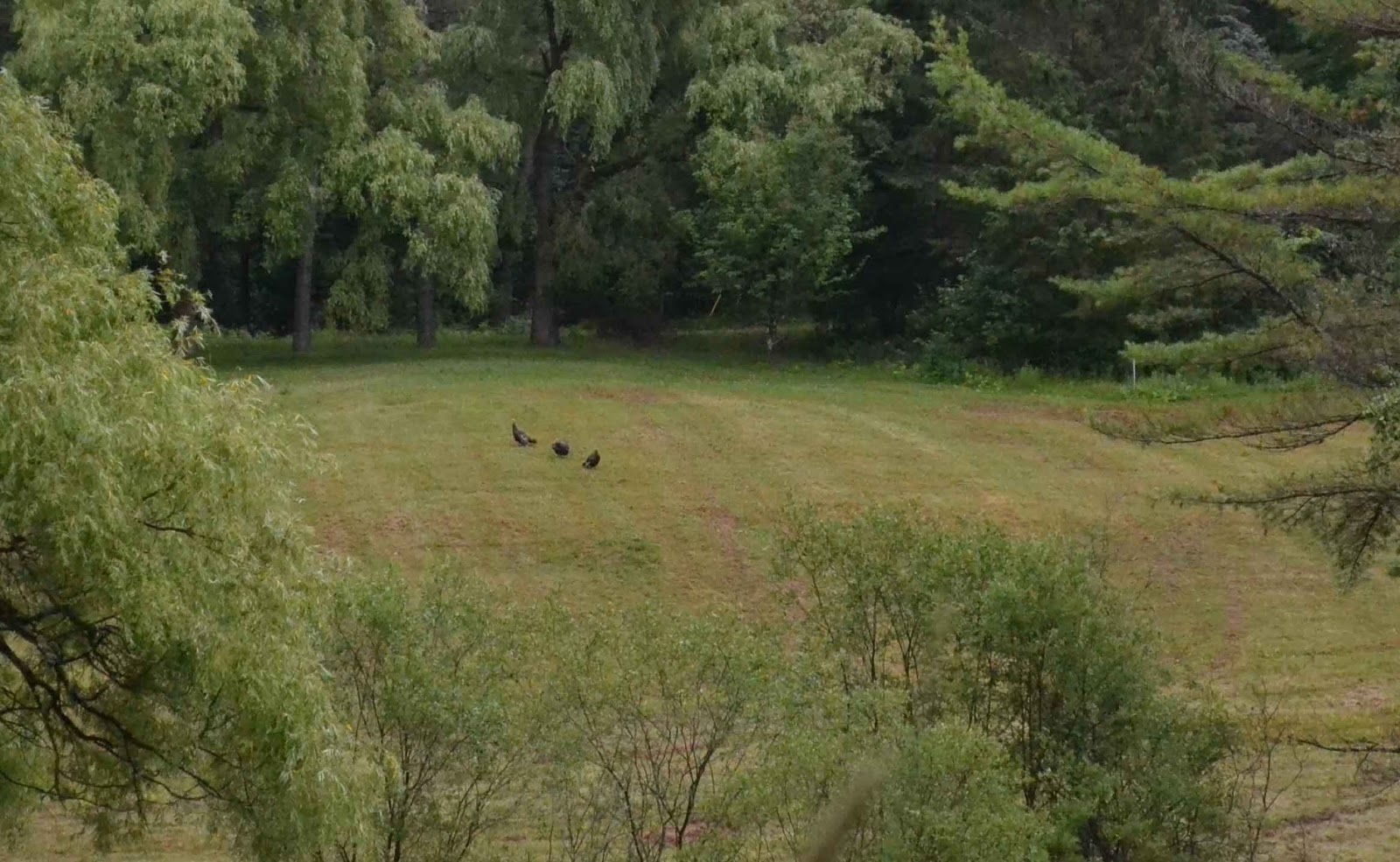
These three hens hav about a dozen poults with them. These were spotted in a field about 150 yards away and the camera lens isn't good enough to make them visible.

Spotted this brood of two hens and six (as best as I was able to count) poults. Some of the poults are visible as the small fuzz just ahead of the left-most hen.

Another small brood to keep an eye upon

Tuesday, June 16, 2015

What Happened to the Body?

When the turkey has been breasted, beard removed, wings cut off and spurs taken there isn't much left to eat. The swamp is a five minute walk from the house and where the remains are left for skunks, coyotes, fisher cats, racoons or whatever will come and eat the leftovers. There is always speculation as to what takes away the the carcass. This year I set the game camera with hopes of catching a glimpse of an elusive bobcat or fisher cat or even the neighborhood dog. What took it away was really surprising.

The carcass just sitting about 50 feet from the hydric soils. No sense in letting a rotting bird contaminate the water any more than nessisary


The tree cover is pretty dense and my surprise was pretty big at having vultures cleaning up the carrion
.
The next photo has no carcass. I can only imagine the vultures picked off enough meat/guts/feathers to lower the weight enough to fly off with the remains.
 My hope was seeing a fisher cat or bobcat or something at least slightly exotic or elusive to the Vermont country side. The vultures are an extremely unexpected but really satisfying substitute. By the time stamps on the photos the vultures had a leisurely meal.

My only regret with the game camera experiment was setting the capture mode with a relatively long delay and shot spacing.  A bit closer timing and the photos might have been more exciting. Seeing the turkey flying again without its own wings would have been really fun. Setting the camera up to capture the entire event is a bit more motivation to fill my autumn tag.

Wednesday, June 3, 2015

Arrow in a Longbeard


The photos from a post ago do spoil the ending of this tale. Filling a tag is just tangible proof of the outcome of the story. Social media and the GoPro are eroding the art of telling a good hunting story by showing the actual truth.

Recently, my family were stuck in traffic while driving to a soccer game. Some of the entertainment of the stop and go driving was reading the bumper stickers veneering a rusted and pretty beat up RV. One piece of wisdom catching my eye was in regards to fishing but can easily extend to turkey hunting. The sticker read: ”Fishermen are born honest but they soon get over it.”

I invite you to sit back, relax, set the lighting to ease any strain on your eyes, and sit with a hand wrapped around your favorite hunting tale beverage. This piece will not be so outlandish it just might be true. This tale is so plain it just might be made up. Read on and decide the validity for yourself.

The bird was 17 lbs. sporting a 9-inch beard. The spurs measured out at 7/8” on each side and my best guess puts him at three years old. The bird died on a Wednesday morning at 5:27 AM when it took an arrow into the chest just besides the beard. The story of his demise began twenty-four hours earlier.

As the days remain lighter in the evening, not many people except for turkey hunters, fishermen, and graveyard shift workers realize the sun breaks the horizon a bit earlier each day. At the start of the season being in the woods at 4:30 AM can require a flashlight. By the end of the season there is enough light at 4:30 to read by. My Tuesday morning hunt was scuttled by my inability or unwillingness to get out of bed before 3:30 AM and into the wood while it was still dark. 

On most hunting days I’ll sit for a while and if nothing materializes the morning is finished out by taking a walk to another field or section of woods. After hunting for 24 days (including two with Nate during youth weekend) without a shot and hearing no turkey noises in the woods this morning, heading home to have a cup of tea and leisurely breakfast felt like the right way to end the day.

Walking home on the dirt road the fatigue from awakening by 4 each morning was catching up with me and fertilizing the negativity I had been harboring about chasing turkeys. Opportunities had presented themselves and without the ability or skill to capitalize upon them, the frustration took center stage. Walking up the road my self image transformed from a 49 year old man to the unsatisfied brattyness of a four year old child who didn’t get his way. Walking down the road I began to sulk and question my decision to hunt at all.

Some sympathetic or mean spirited gobbler must have sensed my dismay and gobbled with the intent of rubbing salt into my wounds. The gobble did not entrench my hopelessness but transformed it into the desire to win. The time was 5:32 and the gobble came from the north and my best guess put the bird near the traversing ski trail. The gobble also kicked off a response of loud and continued barking by our dog who must have been out for his morning stroll. In a straight line I was 350 yards from the house. The bird gobbled again but this time the sound was a bit muffled as it moved away from the road and the dog. Normally a dog chasing of a bird would make me a bit angry but this barking had given away the tom’s escape path.

Wednesday morning I slept in until 4:15. The setup was less then a five-minute walk from the door and tends to be a bit wet. With luck, the bugs wouldn’t be too harsh. But hedged my bet on avoiding too many welts by heading in late.

After grabbing the bow, a small folding chair, and two dekes, the walk settled my excitement. The set-up was completely impromptu which is usually a bad idea. Inevitably there are branches in the way and poor cover.  This morning, as if by magic, a shooting lane appeared.

I set the two decoys and carried the chair twenty yards back into the woods. It was only after sitting down to adjust and level the chair did I see the small group of trees to the right of the decoys. This group of trees was my draw cover. The time was 4:50 AM. Now to just sit and wait.

My view of the dekes. The rootstock on the right is the draw cover which blocked the view of me from the trail.


Finding patients while sitting in the woods is difficult but a skill in need of mastery. So far this season, birds were hanging up and no amount of calling, changing calls, or rhythm would bring them in. Based upon a hunt three days earlier my friend Steve suggested not calling after the initial encounter.

In soccer, basketball, football, baseball; name the sport of choice. Having the ball is the fun part. This holds especially true when we start out. Movement off the ball and the enjoyment of assisting the team only comes later as the athlete matures in the game. With turkey hunting, making the call and hearing the gobble is fun. Turkeys are difficult to find and it is nice knowing they are still nearby, the call and gobble response keeps me interested in sitting still out in the cold or bug infested woods.

At 5:02 a gobbling with moderate volume came from my left. Best guess, and purely a guess, was making the bird 250-300 yards away. Taking a deep breath I placed the striker against the call. Cluck…Cluck….Cluck, followed by a soft yelp, yelp, yelp. The reply came from two overlapping gobbles just as soon as I began the fourth yelp. The call went into my pocket.

The trail which brought the toms to the dekes. My position is on the right up into the woods about 20 yards.
Soon there was more gobbling and the ability to resist calling back was easy. Then the long pause. The woods were silent. A woodpecker pounded at a tree, the sound gobble-like and my nerves began to jitter. Readjusting my seating position shifted the call in my pocket making the slightest noise. Not enough to alert the quiet toms but emitting enough sound to remind me it was in my pocket awaiting its turn to talk turkey.

Thirty seconds or ten minutes later another gobble finds my ears.  The call in my pocket has become animated and is begging me to play it. “Just one cluck” it asks. I resist.

My watch reads 5:17 AM. My fifteen minute sit feels like hours. The call sits in my pocket tempting me like an open bottle of gin sitting on the table of the recovering addict. Nobody is home and what harm is there in one sip? Just a taste to satisfy my curiosity. Do I still enjoy the taste, the light burn as the liquid crosses my tongue? The echoing of the clucks and rasp at the back end of the call?

Movement to my right. My heart begins to pound. Yes, it is a turkey but a single hen. The bird makes its way along the ski trial towards the decoys. The hen is in no rush stopping to peck at something in the grass and scratch at her head while balancing on one foot.  She approaches the decoy and pecks the plastic hen in the neck and turns in my direction. I sit absolutely still. She moves close enough to me I can see her blink and pick out the odd pin feathers on her head. She clucks and purrs and keeps moving away to my left. I watch this hen melt away in the underbrush and wonder how often I’ve walked right past a silent turkey just sitting still in the woods.

Another gobble chorus fills the woods. The birds are close. The release is set into the string loop and the bow sits vertically on my leg. My eyes scan to my right looking for movement. Soon two toms materialize on the ski trail a little over 100 yards away. My heart is pounding with enough force to move the tip of the arrow in perfect synchronization with each beat.

Turkey view of my position.
The birds move together and without stopping come in on the dekes. At fifty yards I can easily make out a beard on both of these turkeys. Either one is a shooter. Twenty yards from the decoys they stop and gobble. At five yards from the hen decoy the twosome passes behind my draw blind trees. The smooth draw of the Elite Energy 35 does its job and in one motion the bow is pulled to the stops and my release hand comes to anchor. Sight alignment is good as my index finger wraps the trigger. I had made the decision to take the first bird with a body shot. Not as sporting as a head and neck shot and a change of my self imposed ethos. The pin settled in at beard level and towards the wing on this front facing quartering shot. The arrow released and the tom flipped over as the arrow entered its body. It lay on the ground and flapped its wings and ran its legs with feet gripping nothing but air.

The second tom stood still and I nocked another arrow to try and tag out. Just as I drew the bow to take the second bird the just shot tom began walking down the trail. I let down on bird number two in order to watch the first bird hobbling away with my arrow sticking out of its side.

The tom entered the woods and settled beneath a fallen hemlock. I gave it a few minutes and slowly approached hoping to not spook it and have it run further into the woods. The bird was laying in the mud of a dryish creek bed. It was alive and looking around. I apologized for not being a better archer and killing it outright feeling a ting of regret about passing on the headshot.  Approaching the bird it tried to leave but not before I pressed its head into the mud and placed another foot onto the body to compress its lungs. It took a few moments but the bird died under my bootsole five minutes after taking my arrow in the chest.

100 or so hours of hunting during the 2015 spring season and I had bagged a longbeard.


Wednesday, May 27, 2015

Got One!

This morning I set up in a spot I had never hunted before. Heard a gobble and responded with a few clucks and a short yelp and decided to do nothing for a while. Two birds arrived and one caught an arrow in the beard. I'll tell the complete tale soon but I had to share this spoiler with you all.


Wednesday, May 20, 2015

An Uncooperative Longbeard


The first half of each spring season has more the feel of a detailed scouting walk then actual hunts. What I mean by this is many of the early season hunts are more learning experiences then shooting events. The set-up is different than originally scouted; the birds move in from the left end of the field and not the center; the birds were just passing through on their way to better feeding and no longer hang out in this patch of woods. In short, early on in the season I seem to get it all wrong.

By the time the turkey’s habits and patterns (if you can call them habits and patterns) are teased out from the general randomness of these critters, they all go quiet. What is certain is the gobbling which began in the trees and worked its way with the toms to the ground has been reduced to tree gobbling only. Once the feet begin making tracks the gobbling stops. Within a week the birds aren’t even gobbling in the trees anymore. Why and how every bird within hearing distance stops making a sound is flummoxing and a bit amazing.  I can understand or at least get my head around birds in a particular location staying silent but not everything in a particular valley or ridgeline. You’d think some ambitious jake who has yet to see any hen action would sound off.

By the second week of the season my hunting has been pretty repetitive. Find a good bow friendly spot (enough room to draw the bow with enough cover to hide the movement) and arrive by 4:30. Set some dekes at 15 and another at 20 yards from the sit. Now my ranges are known. When the time on my watch can be seen without the backlight or when there have been a few consistent gobbles I begin calling. A few soft clucks and maybe a quiet yelp or two. If there is a response to the calls my reply will have a bit more volume and slightly quicker tempo. The extra volume and tempo are how I try to sound “excited and willing” but for all I know my up-tempo and louder calling might be telling the toms to run. After an hour with no action boredom sets in and my legs are slightly numb from sitting for the past 90 minutes. Time for a walkabout to spy a few fields and head back to the house to schedule domestic chores and get off to work. All in all, my hunts have been a nice walk in the morning.

The third Saturday of the season and Nate, my 11 y.o. son, asks to tag along. We repeat the afore mentioned scenario and head back towards home by skirting a swamp. The bugs have yet to hatch and the leaves are just beyond swelled buds. The sightlines through the woods are still long. Soon the understory will occlude the waist to head height views and the ferns will block seeing anything not taller then a grown man’s knees.

Just as we cross the brook I take a quick look around. “Nate, is that a bear?” My finger directs his gaze to a large black lump about 100 yards to the north.

“I don’t think so it looks like a stump.” Then it moves revealing the orange radio collar as the black lump transforms into a black bear. “Oh yea, it’s a bear. What to we do?”

“Just look for cubs and if there aren’t any we should be fine. I don’t think it knows we’re here.”

No cubs so we watch the bear sit and look around before continuing its walk. It moves north, we head home to the south. This was the first bear Nate has ever seen while spending time in the woods. The sighting made the hunt a worthwhile adventure.

After a late morning lunch there are still three hours available to chase turkeys. Trigger time in Vermont is half an hour before sunrise until noon. I’m not too hopeful about finding a late morning tom. The woods have been devoid of turkey calls and my chances of interacting with a tom will be more random luck then echo location.

The three-mile walk on logging roads is a long loop through a stand of about 1,000 acres. Most of it isn’t accessible by vehicles. The sun is bright and the temps are in the mid 40s. My walk consists of moving a few hundred yards until I find decent cover and use the JL boxcall to send a few yelps into the woods. If nothing calls back after a minute or two I keep moving. For the next 90 minutes this pattern is repeated with each calling session slightly less enthusiastic.

Eventually boredom sets in and rather then stop I begin using the scratchbox to play the lead as I cover classic 70’s rock anthems like Led Zepplin’s “Stairway to Heaven;”
 AC/DC’s “Back in Black;” and Kiss “Detroit Rock City.” Still no response from the toms but I really don’t care. I’m tired and hungry.

JL Custom Turkey Calls packages its calls with a basic instruction sheet on reproducing clucks, purrs, yelps, cuts and using a rubber band to center the lid to reproduce a gobble. To gobble with the box call the band holds the paddle to the box and applies light pressure. Next,  the caller either holds the box or paddle while repeatedly shaking the call. The gobble imitation is pretty good. The logging road drops between a large hill and small knoll just a bit longer than ½ mile from home. With no fear of chasing anything off my boxcall gobbling becomes a competition between holding the padle and shaking the box or holding the box and shaking the paddle.

The experiment has been going almost nonstop for two or three minutes when the woods exploded with a loud and presumably close gobble emanating from an actual turkey. I froze to look around and carefully placed the boxcall into my pocket. The bow carry sling was still attached and was removed as I scanned the terrain for a hiding spot. There was none so I scrambles a few yards off the road and gained a few yards of elevation putting me dead level with the top of the knoll. The hillside was steep enough for me to sit or almost lean against and the hemlock branches were far enough above me as to not interfere with the bow.

Dumb luck had a mouth call set like a good jag of chew between my left cheek and gums. The scare of jumping a close tom and sending him packing dried my mouth and the call stuck to my tongue. Another old logging road moved up the hill to the left and the well traveled logging road had three nice shooting lanes with drawing cover radiating from my location.

My first attempt at a yelp to assist the still hidden bird in locating the invading tom and his date was a complete bust. It wasn’t a yelp but more of a raspy choke. The tom bit hard and responded with a harsh gobble which came from the end of the knoll.

The top of his fan breached the edge of the knoll and the bird stepped onto the road in full strut.  Unfortunately there was no shot.  Most of the tom was behind a network of low hobblebush and broken pine limbs. Not certain and arrow would make it through I sucked on my tongue trying to pull up a bit of moisture to release the call reeds.

When the tom spun to display I caught sight of the beard and spurs (6-8” rope with 1”  hooks). The release was set into the D-loop and the bow set vertically resting one cam on my thigh. The shooting lanes were separated by large hemlocks and would provide good cover to draw the bow.  While the tom was looking away I managed a quiet ”come hither” cluck intending to move the bird  two feet and into the road. His fan fell and wings retracted to his body. The bird moved up the knoll through the underbrush and began scanning the hillside for this elusive hen.

The tom is only twenty yards afar and shooting it is a dead level chip shot with one problem. There is an awning of branches across the road low enough to interfere with the arcing flight of the arrow. I still have no shot so time to sit and wait for the bird to leave the knoll and head up the hill to find this seductive hen.

In Tom Kelly’s book,  “A Fork in the Road,” the master recommends setting up so the hunter has a clear view of any road and to establish a spot to have a shot into both roads at any intersection. But dumb luck I have this and it should only be a matter of time before I can verify Mr. Kelly’s wisdom.

The longish beard gobbles and struts on the top of the knoll. He has center stage and puts on a fantastic show. The turkey is close enough I can hear the fan pop open and wingtips tickle the leaves. After each strutting event, the bird preens itself and the shaking feathers leave a rustling sound in the late morning air.

When the bird turns his back I can glance at the watch on my release hand. The small bumps of rock and forest floor debris which I hadn’t noticed when I scrambled in, now pressure my rear end in a rather uncomfortable way. I’ve been sitting motionless for thirty minutes. The arrogance of the tom expecting the hen to some to him is second in amazement to his ability to just sit and wait. As the pain in my butt grew, my patients thinned.

At forty-five minutes the bird descended the knoll back towards the logging road. Each step closer to the road kicked my heart rate back up a notch. My thumb felt for the hook of the release to be sure the D-loop was still engaged. In season’s past, I rushed the shot by skipping the waypoints of the shot process causing the arrow to miss the target. .As the tom stepped up to the first 25 yard shooting lane I ran through the shot checklist: Anchor at the jaw; curl the finger over the trigger to the last knuckle; elbow in line with the arrow flight; align the sight housing and peep; lower the elbow to release the shot.
The two logging roads came together at a very acute angle on the steep hillside. The space between the roads was occupied by a band of  incompetent rock and broken stone. Which I knew was there but was unable to see from my current position.  Given the choice between scaling the fragmented defile of broken and crumbly rock or an easy stroll up a fairly well defined and graded road, the choice, for a human, is a no brainer. The easy footing of the road wins. For a strutting tom turkey showing off to a sexy hen, only the miserable path will enhance his aversion to danger.  The bird managed to skirt the easy shot and remained out of view only giving away his position by gobbling at the top of the rise. “Rats!” was my audible reaction (we all know it wasn’t rats). Was I busted and the bird was toying with me? Was the bird in need of a bit of dangerous fun hence it scaled the path of most resistance? Doesn’t matter. My shot opportunity was gone.

I snuck up the hill scratching away the leaves hoping to imitate a love struck hen chasing the masculine hunk up the hill and cover my moves. The bird stayed forty yards ahead of me gobbling at every bench in the terrain. At noon, the end of legal trigger time, I looked up to see the tom backlit by the sun. His red waddles made transparent by the strong noontime light. The body a silhouette with one wing extended while the arching middle feather displayed in my direction.


Tuesday, May 19, 2015

More Hunting Stories on the Way

Hello Readers,
Sorry for the gap in the posting. There has been an unexpected bit of good fortune at the house. My daughter has been recruited to play soccer at a private school. This came out of the parking lot of left field it was so unanticipated.

The application process has been quite busy writing letters and entrance essays. Not just my daughter. The school also wants something from me and my wife. We have one small laptop at the house which is used by everyone so keyboard time has been limited.

In the past week there have been some awesome hunting adventures to share with you.  I'll get them up soon and thanks for the patients with this.

Be well, Kevin


Tuesday, May 12, 2015

The First Great Hunt of the Season.


The seventh day of the 2015 spring season fell on a Thursday. This day was the first great hunting day of the season.

6:30 Wednesday morning when driving towards home after a whole unsatisfying hunt, I spotted three toms displaying in the field by the tree. The location is a fifteen-minute walk from the house traversing fields with a few strips of woodland to wade through. After work, the dog needed a good walk so heading to the tree to see if any branches needed trimming was the mission.

For the past two years I’ve been in grad school with the intention of finding a better paying career. Hasn’t quite worked out as planned. To earn some cash I continue to work as a landscaper and fine gardener. Any holes being cut along field edges and beneath pine trees are always pruned in with cut made for visual appeal in addition to good horticultural practice. While the dog sniffed around in the grass, my ten minutes removed a few buckthorn and honeysuckle saplings along with some deadwood to fashion a bowhunter sized grotto. Judging distance in dim light is often difficult.  A few of the cutoffs were pressed into service demarcating 15, 20, and 25 yards.

Thursday at 4:45 the dekes were set at 20 yds. The calls were properly arranged on my leg; one arrow on the nock and another set to the side in case a second shot presents itself. Time to just sit and enjoy the increasing light and wait for the show to begin.

By 5:00 there had been a few far off gobbles but nothing sounding close enough for a response. When a gobble came from the next field over a bit of second guessing set in about my location. Too late to move so just sit it out.

The crack of sticks coming from the woods to my right caught my attention bringing me from near boredom to pie eyed. Moving my eyes to the limit in order to peek with minimal movement preceded a slow turn of the head, my eyes scanning the trees. A short flash of white gave the deer away.  Two does moved with caution along the woods line stopping to bob their heads before dipping them down to nibble on the new sprouts just breaking the from beneath the soil. The wind didn’t betray my location and the deer approached the decoys moving past me at 15 yards. For once I could smell the deer without being detected. The decoys have lured in more deer than turkeys.

The deer left the field and the only sounds were songbirds and the breeze moving the swollen buds causing the branches to rub against each other. A crow flew overhead cackling to its mates. A few geese passed above. Never saw them but heard the reverberation of honks. My watch read 6:15 and if something wasn’t dead in fifteen minutes it was time to break camp and head home to begin the workday.

A faint yelp made it over the rise from the swamp into the field. The double sided cedar scratchbox responded with a few clucks and cuts. Several hens responded. My calling cut them off. With the clock working against me trying to sweet talk any following toms didn’t seem a good bet. Angering the hens seemed like a good play. If the girls come looking for a fight just maybe the boys will follow them in.

The other side of the cedar scratchbox has a bit higher pitch. Drawing it across the walnut peg gave a loud  series of raspy yelps which were cut off by the hens closing in on my hide out. A few minutes of frantic yelping brought two hens into the field. The handheld calls were placed into my boot top to keep them available and quiet. The release hook slid through the D-loop with my finger pressing the backside of the trigger blade to avoid an unintentional disconnect. The bow rotated from the horizontal resting position on my thighs to the vertical alignment needed to draw and shoot.

The hens moved across the field towards the dekes; their heads scanned from side to side. Yelp yelp, in rapid succession, short pause, yelp yelp, short pause; this pattern just kept repeating itself.  An occasional cluck broke the pattern but the hens kept up this banter of one to three short yelps.

Being female it was illegal to shoot these birds during the spring season. Some insect began boring into the exposed forehead just above the head net. My instinct was to swat the bug but fear of getting busted and sending the hens into alarm mode overrode the need to stop the bug from biting me. Slow movement might be okay. The move to my forehead was deliberate and steady.. The hens were looking in my direction when my index finger popped the insect. The hens continued yelping and moving my way.

When they stopped a few yards from the decoys my watch read 6:30. I had to leave soon and with no evidence of approaching toms the bow was lifted into a shooting position. The bowstring remained still as my draw arm pantomimed coming to anchor. While at “full draw” the hens shook out their feathers adding a bit of rustling to the cacophony of the morning. They didn’t spook validating my 3-D camo and technique.

With the same deliberation as squishing the bug on my forehead, my foot located several dried sticks shed from the pine tree. Snapping them made the hens nervous and soon they made a purposeful escape back into the woods.

Why was this hunt so successful? The camo works fantastically well allowing me to draw on birds only 12 yards away. Listening to the hens communicate was insightful. I hadn’t realized the yelp was common vernacular. Until this mo hunt it was assumed the yelp was a longer series and used only in the vicinity if toms. My odds of becoming a harvester this spring had just gone up.